
Quick Answer
What actually changed in the US student visa rules?
If you’ve been planning to study in the USA, you’ve probably seen the headlines and felt your stomach drop. Take a breath. The rules are stricter, but this isn’t a ban. Most of it comes down to planning.
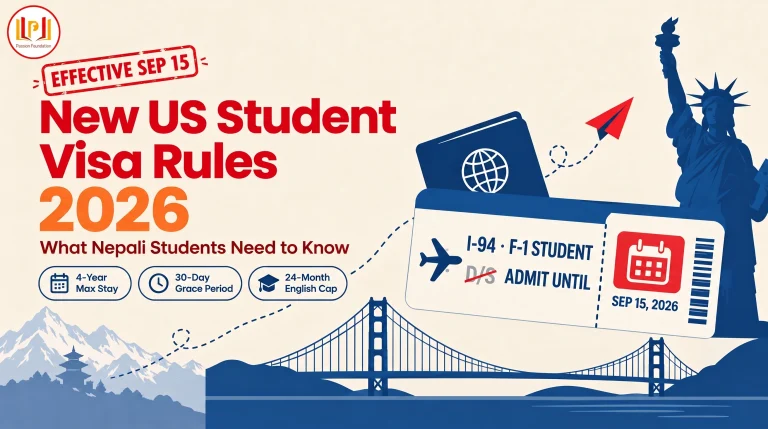
On July 17, 2026, the US Department of Homeland Security published a final rule, and it came into effect on September 15, 2026. Before that, almost every F-1 student was admitted for “duration of status” (D/S). Your I-94 simply said D/S, and you could stay as long as you kept studying and followed the rules. There was no printed end date.
That’s gone for new arrivals. Now your I-94 shows a specific Admit Until Date. Think of it like a train ticket with a departure time printed on it, instead of an open return.
The new rules at a glance
| What | Before | Now |
|---|---|---|
| Length of stay | Open-ended (D/S) | Fixed date on I-94, up to 4 years |
| Time to leave after your program ends | Up to 60 days for many students | 30 days |
| Need more time? | No extension needed | Apply for an extension of stay |
| Changing program or level | Easier in practice | Tighter limits, especially for graduate students |
| English language courses | No overall cap | 24 months in total |
One thing to remember: USCIS makes the final decision on extensions, so never assume one is automatic.
Does this affect you?
It depends on where you are on the timeline.
- Applying now for a future intake: Yes. You’ll enter under the new system, with a fixed date on your I-94.
- Already studying in the US on September 15, 2026: Mostly no. Students in valid status generally continue under transition provisions, with no immediate action needed. If you travel abroad and re-enter after that date, though, you could be admitted under the new system, so talk to your university’s international student office before booking flights.
- Planning to transfer or start a second program: Yes. The transfer limits below matter for you.
What this means for Nepali students planning to study in the USA
Here’s where we’d put your energy.
Pick your program with its end date in mind. Your I-20 end date now shapes your admission date. A realistic program length beats an optimistic one you’ll have to extend.
Treat your first program as your real program. Students who complete a program after September 15 generally can’t use F-1 status to begin another at the same or a lower level. A plan like “start with a cheaper diploma, then switch to a better university” is much riskier than it used to be. Choose your destination school carefully the first time.
Don’t build your plan around English courses. English language training is now capped at 24 months in total. If your IELTS or PTE score is low, it’s smarter to improve it here in Nepal before you apply.
Show a clear, honest study plan. According to data from the Nepal Immigration Department, only 1,673 students from Nepal opted for the USA up until mid-July 2026 out of the total 66,000 students studying outside their country. The trend was declining even before the implementation of this law, so making a practical decision becomes all the more important.
Common myths about the new rules
Myth: You can only study in the US for four years now. Not quite. Four years is the maximum for each admission period, not a lifetime cap on F-1 status. If you need longer, you can apply for an extension.
Myth: Students already in the US have to leave. No. The rule doesn’t make anyone leave immediately, and students in valid status are covered by transition provisions.
Myth: The US visa bond applies to students. It doesn’t. The bond covers B1/B2 business and tourist visas. Nepal has been on that list since January 2026, and the final rule raised the maximum bond to $20,000. It matters if a relative is planning a visit, but not for your F-1 application.
Your pre-application checklist
- Ask each university how long your program usually takes to finish, and pick one you can complete in that time.
- Do not think of transferring or changing levels after you come here.
- Prepare your IELTS, PTE or Duolingo scores before you apply, rather than using English classes.
- Verify your I-20 form, and upon entry your I-94 form. Your end date will be on your I-94 now.
- Maintain your full-time registration, SEVIS and other documents.
- Discuss your situation with the international student office at your university.
Is the USA still worth it? An honest take
Yes, for the right student. The US is still open to international students, and US education providers say the changes shouldn’t put well-prepared applicants off. But it now asks for more planning and leaves less room to change course once you arrive.
If a fixed timeline worries you, it’s fair to compare other options on cost, visa process and what happens after graduation before you decide. We guide students to South Korea, Japan, Finland and Denmark as well, and each has its own rules and trade-offs. If you’re leaning towards Korea, start with our student visa documents guide. Our job is to help you compare honestly, not push one country. You can also read our full Study in USA page.
FAQ
Do the new US student visa rules apply to Nepali students?
Yes. If you enter the US in F-1 status on or after September 15, 2026, the same rules apply to you as to every other nationality.
What is an Admit Until Date?
It’s the date on your I-94 showing how long you can stay. For most students it follows the end date on the I-20, up to a maximum of four years.
Can I still change universities?
Yes, but with stricter conditions, especially for graduate students, and for those who are completing their program and going to pursue another one at the same or a lower level of education. You must consult with the international office of the university first.
Is the visa bond applicable to F-1 students?
No. It is applicable to B1/B2 business and tourism visas only.
What will happen if I cannot complete my study program within the period specified on my visa?
You can apply for extension of stay, but it is decided by USCIS.
Final thoughts
The new rules don’t close the door on the USA, but they reward students who plan carefully. If you’re weighing the US against other countries, or aren’t sure which program and university fit your profile, book a free counselling session with us and we’ll talk it through honestly.
This article is general information, not legal or immigration advice. Rules can be challenged or updated, so confirm the latest details on Study in the States, travel.state.gov and with your university’s international student office. Last updated: October 14, 2026.